Chapter IV
The Human
Einstein the Man: Beyond the Equations
Behind the wild hair and the equations was a man of extraordinary complexity: a refugee who fled the Nazis, a pacifist who inadvertently helped create the atomic bomb, a violinist who composed thought experiments while playing Mozart, a civil rights advocate who called racism "America's worst disease."
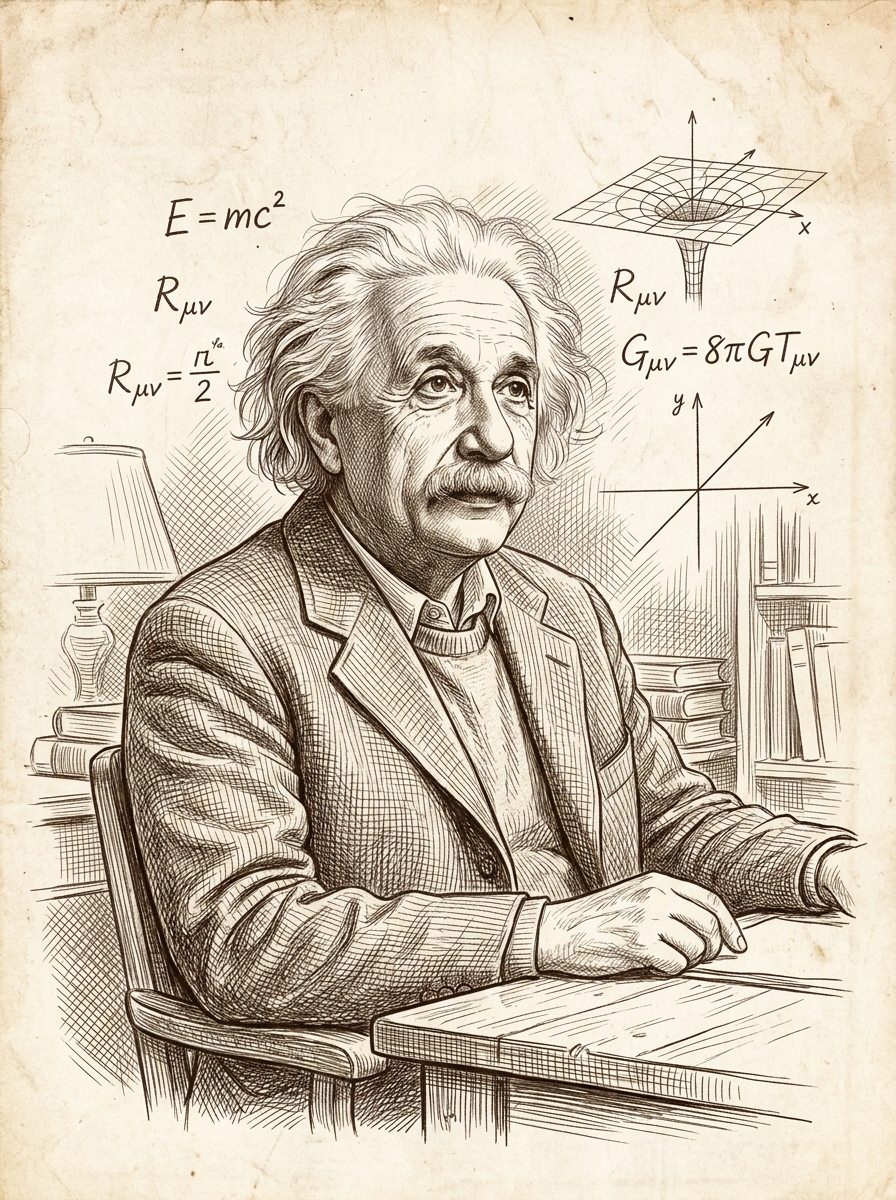
Albert Einstein, Modern Renaissance sketch portrait
The Violinist
Einstein began violin lessons at six and played throughout his life. He was devoted to Mozart and Bach, saying music helped him think. 'When I examine myself, I reach the conclusion that the gift of fantasy has meant more to me than my talent for absorbing positive knowledge.'
The Patent Clerk
From 1902 to 1909, Einstein worked as a technical expert (third class) at the Swiss Patent Office in Bern. The work sharpened his ability to identify the essential physics beneath complex systems, and left him enough mental energy to revolutionize physics.
The Pacifist
Einstein was a committed pacifist for most of his life. He refused to sign the 1914 'Manifesto of the Ninety-Three' justifying German militarism. In 1955, days before his death, he co-signed the Russell-Einstein Manifesto urging nuclear disarmament.
The Dreamer
At sixteen, Einstein asked himself: 'What would a light beam look like if I rode alongside it?' This thought experiment (a decade of contemplation) led to special relativity. 'Imagination is more important than knowledge,' he insisted.
The Refugee
When the Nazis came to power in January 1933, Einstein was abroad. He never returned to Germany. His property was confiscated, his works included in book burnings. He settled permanently at Princeton's Institute for Advanced Study, where he became an American citizen in 1940.
The Civil Rights Advocate
Einstein joined the NAACP and called racism 'America's worst disease.' When the contralto Marian Anderson was refused a hotel room in Princeton, Einstein invited her to stay at his home, the beginning of a lifelong friendship. In 1946, he delivered a speech condemning segregation at Lincoln University.
The Philosopher of Science
Einstein rejected the atheist label, describing himself as a 'deeply religious nonbeliever.' He believed in 'Spinoza's God,' the divine as identical with the laws of nature. 'The most beautiful thing we can experience is the mysterious,' he wrote. 'It is the source of all true art and science.'
The Unfinished Quest
Einstein spent the last thirty years of his life seeking a unified field theory: a single geometric framework encompassing gravity and electromagnetism. He never found it. On the morning he died, April 18, 1955, a notebook of field equations lay open on his bedside table.
"I want to go when I want. It is tasteless to prolong life artificially. I have done my share; it is time to go. I will do it elegantly."