Chapter III: 1919 to 2026
A Century of Proof
Five Milestones Across One Hundred Years
Einstein's general theory of relativity has passed every experimental test for over a century, from Eddington's sun-drenched eclipse plates in 1919 to LIGO's ghostly gravitational wave echoes in 2015, to the first photograph of a black hole's shadow in 2019. Scroll through the milestones.
Eddington's Eclipse
Two British expeditions measured the deflection of starlight during a total solar eclipse. Eddington's results (showing 1.75 arcseconds of bending, exactly Einstein's prediction) electrified the world. The Times of London declared 'Revolution in Science.' Einstein became the most famous scientist in history overnight.
J.J. Thomson, discoverer of the electron, called it 'one of the greatest achievements in the history of human thought.' Einstein had become a household name in every language on Earth.
Hulse-Taylor Binary
Russell Hulse and Joseph Taylor discovered PSR 1913+16, a pulsar in a binary system with another neutron star. Over years of observation, they found the orbital decay matched general relativity's prediction for energy loss via gravitational wave emission with extraordinary precision.
This was the first indirect evidence for gravitational waves. Hulse and Taylor received the 1993 Nobel Prize in Physics for this discovery, which pointed unmistakably toward the existence of the waves Einstein had predicted in 1916.
LIGO Detection
On September 14, 2015, LIGO's twin detectors simultaneously recorded a gravitational wave signal from two merging black holes 1.3 billion light-years away. The detectors measured a change in arm length smaller than one ten-thousandth the diameter of a proton, a feat of measurement precision without parallel in human history.
The peak power output at the moment of merger was approximately 50 times that of the entire visible universe combined, radiated as gravitational waves in a fraction of a second. Weiss, Thorne, and Barish received the 2017 Nobel Prize in Physics.
Event Horizon Telescope
The Event Horizon Telescope, a planet-spanning array of radio telescopes, captured the first direct image of a black hole. The target was the supermassive black hole at the center of galaxy M87, with a mass 6.5 billion times that of our Sun. The image showed precisely the 'shadow' predicted by general relativity.
Science magazine named it the Breakthrough of the Year for 2019. The image was strikingly consistent with theoretical simulations based on Einstein's equations, providing visual evidence for event horizons and confirming general relativity in one of the most extreme environments in the universe.
GW250114
On January 14, 2025, LIGO observed GW250114, described as the clearest black hole collision signal yet recorded. The event provided one of the sharpest tests so far of Einstein's predictions in the strong-gravity regime, with the observed signal matching general relativity's expectations.
Subsequent analyses published in 2025 showed that GW250114 offered an unusually clean ringdown signal, enabling stringent single-event tests of Kerr black-hole behavior and Hawking's area law.
O4 Reaches 200 Detections
By March 2026, the LIGO-Virgo-KAGRA collaboration had announced the 200th gravitational-wave detection of the O4 observing run. These events span merging black holes, neutron stars, and mixed systems, extending general relativity tests deep into the strong-gravity regime without yielding a confirmed deviation from Einstein's theory.
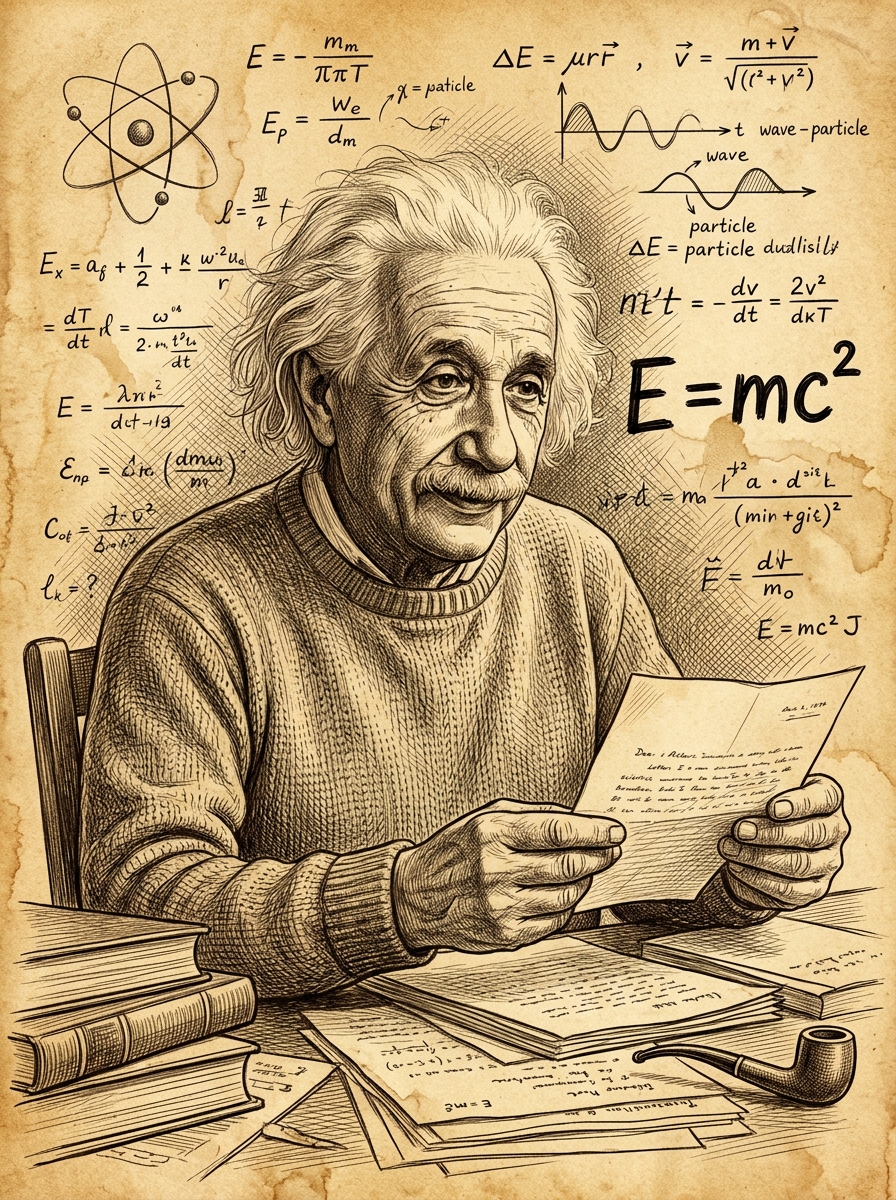
Einstein at Princeton, late years
Princeton, 1940s–1955
"I Never Doubted It for a Moment"
Einstein spent his final decades at Princeton's Institute for Advanced Study, a refugee from a continent in flames. While the world caught up to his 1915 theory, he pursued a grander ambition: a unified field theory combining electromagnetism and gravity. He did not succeed, but the quest never dimmed his conviction in his own equations.
When Eddington's 1919 results arrived, a student asked Einstein what he would have done if they had contradicted general relativity. He replied: "Then I would have been sorry for the dear Lord. The theory is correct."