Chapter II: 1907–1915
General Relativity
Gravity as the Curvature of Spacetime
Ten years of extraordinary intellectual labor (the most strenuous effort of Einstein's life) yielded the most elegant theory in all of science. Gravity is not a force. It is the curvature of spacetime itself, shaped by the presence of mass and energy.
The Einstein Field Equations: November 25, 1915
"Spacetime tells matter how to move; matter tells spacetime how to curve."
Interactive Gravity Well
Click to place mass centers. The fixed chart stays faint; contours and field lines are both derived from the same weak-field spatial depth.
1907
The Equivalence Principle
Einstein's 'happiest thought': a person in free fall does not feel their own weight. The effects of gravity are locally indistinguishable from acceleration. This simple insight took eight years to become a complete theory.
1912–1915
Curved Spacetime
With Marcel Grossmann's help, Einstein mastered Riemannian geometry, the mathematics of curved spaces. He reformulated gravity not as a force acting between masses, but as the geometry of four-dimensional spacetime shaped by energy and momentum.
November 1915
The Perihelion of Mercury
When Einstein calculated that his field equations perfectly explained Mercury's 43-arcsecond orbital precession (a 50-year mystery) he was so excited he suffered heart palpitations. General relativity had its first triumph before any new experiments were conducted.
Berlin, 1915
"The Most Beautiful Theory in All of Science"
After ten years of relentless intellectual struggle (years Einstein later described as the hardest of his life) he stood before the Prussian Academy of Sciences in November 1915 and presented his completed field equations. The room fell quiet. He had rewritten gravity itself as the curvature of four-dimensional spacetime.
David Hilbert, the greatest mathematician alive, was racing him to the same equations. Einstein arrived at the physical interpretation; Hilbert at the mathematical derivation. Both arrived within days of each other. Priority has remained a scholarly debate ever since.
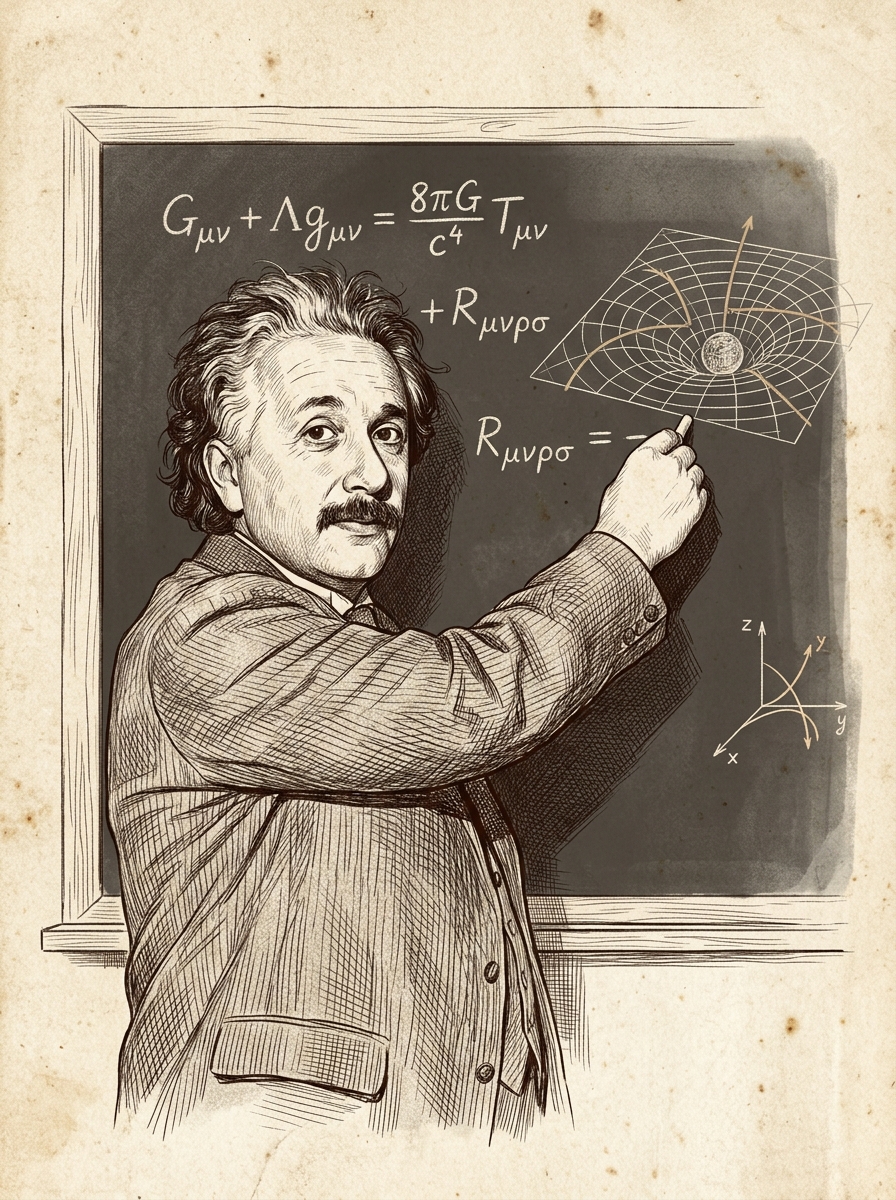
Einstein at the blackboard, Berlin, 1915
"The general theory of relativity...compels us to describe our world by a geometry more general than the Euclidean geometry familiar to common sense."